
- News
- City News
- thiruvananthapuram News
- Floods persist despite costly cleanup efforts
Trending
This story is from January 8, 2024
Floods persist despite costly cleanup efforts
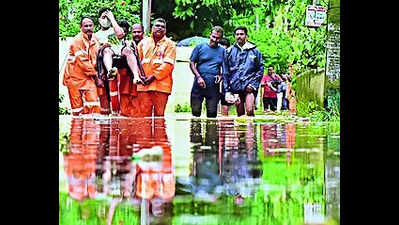

Following flooding in the city in 2021, irrigation department prepared an initial study report on flood mitigation. The study identified around 500 vulnerable points in the waterbodies which required immediate attention. A data bank was created on these points and is being reviewed. Additional chief secretary ( water resources) had directed that each waterbody has to be assigned an officer to identify bottleneck points.
As per the report, frequent cleaning to avoid delta formation inside the waterbodies, identifying waste dumping areas for regular cleaning, steps to be taken by corporation to prevent further dumping of wastes into waterbodies, preventing growth of vegetation inside the waterbody were proposed as steps to be taken on a war footing. Installation of CCTVs and fences were also recommended.
The report noted that the most severe and frequent flooding in the city occurs at Thampanoor, East Fort, Uppidamoodu and Kannammoola. The flooding in these areas occurs three to six times during monsoon. The average water depth is 0.6m to 1.2m and persists for two to 24 hours in the central part and three to four days in the southern part of the city. The drainage network of the city consists of two major rivers namely Karamana and Killi, a few canals, their feeders and lakes, the project report said.
We also published the following articles recently
NGO requests Chennaiites to share details of floods in their areas
Arappor Iyakkam, an anti-corruption NGO, is conducting a flood audit in Chennai. The NGO has requested Chennai residents to share details about how their areas flooded during cyclone Michaung. Residents can use an online form provided by the NGO to share details and photos. The collected information will be used to prepare a report. The report will be presented at a 'Kelu Chennai Kelu 3.0' event in Chennais Valluvar Kottam on February 4.
Arappor Iyakkam, an anti-corruption NGO, is conducting a flood audit in Chennai. The NGO has requested Chennai residents to share details about how their areas flooded during cyclone Michaung. Residents can use an online form provided by the NGO to share details and photos. The collected information will be used to prepare a report. The report will be presented at a 'Kelu Chennai Kelu 3.0' event in Chennais Valluvar Kottam on February 4.
10-yr Vaigai river rejuvenation work from tomorrow in phases
TNRM and farmers organizations, including KAFA, will clean and restore Vaigai river in 10 phases. The first phase will begin in Madurai city on Monday. The project aims to remove prosopis juliflora, water hyacinth, and alien plants, ensuring clear channelization and uninterrupted water flow. The 10-year rejuvenation plan includes capacity building, awareness programs, and a river water parliament. Currently, Rs 10 lakh has been mobilized from CSR and NGOs, with more funds expected to flow in.
TNRM and farmers organizations, including KAFA, will clean and restore Vaigai river in 10 phases. The first phase will begin in Madurai city on Monday. The project aims to remove prosopis juliflora, water hyacinth, and alien plants, ensuring clear channelization and uninterrupted water flow. The 10-year rejuvenation plan includes capacity building, awareness programs, and a river water parliament. Currently, Rs 10 lakh has been mobilized from CSR and NGOs, with more funds expected to flow in.
Want to know causes of and solution for Chennai floods?
A free technical workshop or datajam on the causes of and solutions for the floods in Chennai will be conducted at IIT Alumni Industry Interaction Centre. The workshop is organised by OpenCity, Citizen Consumer and Civic Action Group, and Information and Resource Centre for the Deprived Urban Communities. Participants can use open data to analyse the causes of flooding, the implications in different parts of Chennai, and recommend solutions. To register for the workshop, click bit.ly/datajam-jan24.
A free technical workshop or datajam on the causes of and solutions for the floods in Chennai will be conducted at IIT Alumni Industry Interaction Centre. The workshop is organised by OpenCity, Citizen Consumer and Civic Action Group, and Information and Resource Centre for the Deprived Urban Communities. Participants can use open data to analyse the causes of flooding, the implications in different parts of Chennai, and recommend solutions. To register for the workshop, click bit.ly/datajam-jan24.
End of Article
FOLLOW US ON SOCIAL MEDIA










Photostories

Hot Picks
TOP TRENDING
Popular Categories
Hot on the Web
Top Trends
World First Top 10 TrillionairesVinesh Phogat Election ResultTravis KelceElection Results 2024Haryana Election ResultJason KelceJammu Kashmir Election Result 2024Israel Hezbollah WarHardik SinghAakash ChopraAssembly ElectionJammu Kashmir Election Winners ListGurgaon Election ResultHaryana Election Winners ListLive Election ResultFaridabad Election ResultLive Cricket Score
Trending Topics
Tulsi KumarBigg Boss Tamil 8 Contestants ListAjay DevgnNavratri Colours 2024Sanjay Leela BhansaliDurga Puja 2024Bigg Boss 18 House PhotoDevara CollectionBigg Boss 18Deepika PadukoneShailesh LodhaDevaraGovinda NewsNational Film Awards 2024Swatantrya Veer SavarkarColdplay India tour 2025Watch NFL Live StreamDress To ImpressCall Of Duty Black Ops 6Wordle Answer
Living and entertainment
Latest News
Ambala Cantt Assembly Election Result 2024: BJP's big gun Anil Vij defeats Chitra Sarwara by over 7000 votesThe Power of Navratri: Honoring Goddess Durga and Manifesting Desires3 reasons why Jimmy Uso can betray Roman Reigns and join forces with Solo SikoaThis is the stock trading app linked to Rs 500 crore investment fraud; YouTubers Elvish Yadav, Bharti Singh among 5 summonedMonetary policy committee meet: RBI moving closer to rate cutIndian branded pharma sector to see a decline in growth: Report2024 Haryana assembly election result: 5 reasons why BJP's victory is significantKathua (SC) Assembly Election Result 2024: BJP's Dr Bharat Bhushan wins by 12,177 votesHappy Durga Puja 2024: Best Messages, Quotes, Wishes, and Images to Share on Durga PujaTaylor Swift surpasses Rihanna in Music Rich list: A look at her impressive net worthAlexander Zverev scrapes through, set to face David Goffin at Shanghai Masters pre-quartersRoh Yoon Seo shines as a supportive sister in 'Hear Me: Our Summer'Best TVs Of 2024 In India: Top Picks For Every BudgetSuhana Khan pens a fun caption directed to Shah Rukh Khan and Karan Johar along with picture of ‘birthday girl’ Gauri KhanKarcher launches autonomous cleaning devices, robotic vacuum cleaners; aims to expand India operationsHaryana Election Results: Why Jalebi is trending and its association with Rahul GandhiThe price of Karan Johar's blonde braid tie will make your jaw dropRanveer Brar recalls how Hansal Mehta instilled confidence in the chef-turned actor after his first shot
Copyright © 2024 Bennett, Coleman & Co. Ltd. All rights reserved. For reprint rights: Times Syndication Service